
Mental Math for 101 Okey: the Middle × 3 Trick
The shortcut experienced players use to check the 101 threshold in two seconds — sum the middle tile of each formation, multiply by 3, gate at 34. Worked examples for 4- and 5-tile runs, plus when the trick fails.
Mental Math for 101 Okey: Open Faster with the Middle × 3 Trick
Adding 21 tile values in your head takes ten seconds you don't have. Experienced players don't do it. They use a one-line shortcut that turns the 101-point opening check into mental arithmetic so fast it feels like cheating: sum only the middle tile of each formation, then multiply by 3.
Here's why it works, when it works, and the two corner cases where it doesn't.
The shortcut
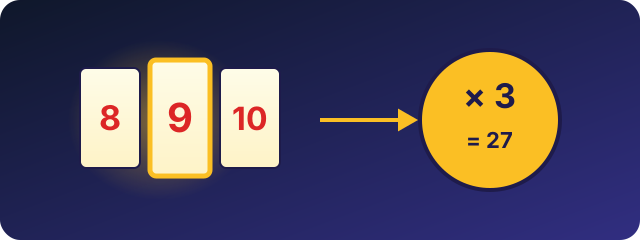
Any 3-tile run sums to three times its middle tile:
- 8-9-10 = 27 = 3 × 9
- 10-11-12 = 33 = 3 × 11
- 5-6-7 = 18 = 3 × 6
Same identity for 3-tile sets:
- 11/11/11 in any three colours = 33 = 3 × 11
- 6/6/6 in any three colours = 18 = 3 × 6
That's the whole secret. Three tiles of value m always sum to 3m. So the question "do my formations cross 101?" collapses to "do their middles sum to 34 or more?" — because 34 × 3 = 102, which is ≥ 101.
A worked example
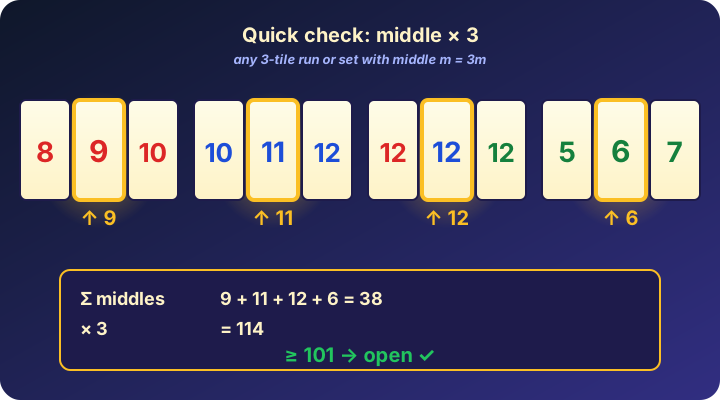
Your hand has four formations. Their middle tiles are 9, 11, 12, 6.
- Sum the middles: 9 + 11 + 12 + 6 = 38
- Multiply by 3: 38 × 3 = 114
- 114 ≥ 101 → open
Two seconds. No need to add 8+9+10 + 10+11+12 + 11+12+13 + 5+6+7 in your head.
Runs of 4 or 5
Decompose: take the central three tiles, then add extra ÷ 3 to your middle-sum for each leftover tile.
Example: 9-10-11-12 (four tiles).
- Central three = 10-11-12, middle = 11
- Extra tile = 9, so 9 ÷ 3 = 3
- Contribution to middle-sum: 11 + 3 = 14
- × 3 at the end = 42, exactly equal to 9+10+11+12 ✓
Example: 7-8-9-10-11 (five tiles).
- Central three = 8-9-10, middle = 9
- Extras = 7 and 11, so (7 + 11) ÷ 3 = 6
- Contribution: 9 + 6 = 15
- × 3 = 45, exactly equal to 7+8+9+10+11 ✓
The math holds because an n-tile run is the sum of the central 3 (= 3 × middle) plus the extras (= sum of extras). Dividing the extras by 3 inside the middle-sum and multiplying by 3 at the end is algebraically the same operation.
Sets of four
Same trick. A 4-set of 11s: middle is still 11 (it's the value of the set). The fourth tile adds 11 ÷ 3 ≈ 3.7 to the middle-sum on top of the 3-of-a-kind baseline.
In practice, round to 4 — the trick is a gate, not an exact calculation.
When the trick breaks down
Two corner cases worth knowing:
The joker. The joker takes the value of whatever tile it stands in for. Inside a 3-run 10-J-12 (joker = 11), the middle is still 11 — trick works. But if you slot the joker as the first or last tile of an extended run, the "middle" you're looking at is no longer the joker's value. Quick rule: substitute mentally first, then apply the trick.
Adjacent runs in the same colour. If you mentally lump 5-6-7-8-9 as one big run when you actually intend to split it into two groups, the trick over-counts. Always commit to which 3-tile groupings you're laying down before you start summing.
The threshold gate in practice
Memorise this: 34. If your middle-sum reaches 34, you can open (102 points). At 35 you have a small buffer. At 40 you're sitting on 120 and should have opened a turn ago.
| Middle-sum | × 3 | Status |
|---|---|---|
| 30 | 90 | not yet — need 11+ more from one tile |
| 32 | 96 | almost — one good extension or a 4-set |
| 34 | 102 | open |
| 38 | 114 | comfortably over |
| 45+ | 135+ | you waited too long |
A drill to internalise it
For a week, every time you draw a tile in a real game, do the middle-sum mentally before doing anything else. Compare against your honest-arithmetic answer. Within a few sessions the middle-sum will be the only number you bother computing.
Read next
- Opening and scoring rules — the full picture of what you're trying to cross with this trick.
- Best opening strategies — when to actually open once you know you can.
- Five essential strategies — five battle-tested habits, of which mental math is one.