
Understanding the Joker (Okey) and the Smiley
How the indicator determines the okey, what the smiley false-jokers actually do, and when to play the joker versus hold it.
Understanding the Joker (Okey) and the Smiley
The joker — okey in Turkish — is the single most important tile on the table. It's worth more than its face value, it determines the strategic direction of the round, and it's the difference between a normal finish and a doubled one. This article unpacks how the joker is chosen, what the smiley false jokers actually do, and how experienced players decide whether to play their joker or hold it.
How the indicator picks the joker
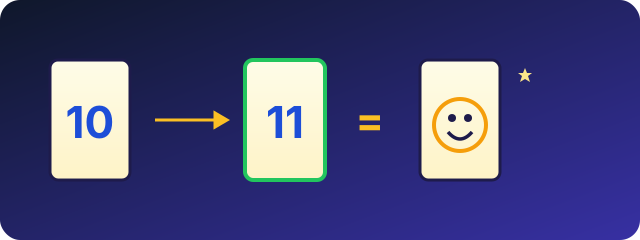
At the start of every round, one tile is flipped face-up from the draw pile. That tile is the indicator (Turkish gösterge). It will not move and will not be played for the rest of the round. Its only job: determine which tile is the joker.
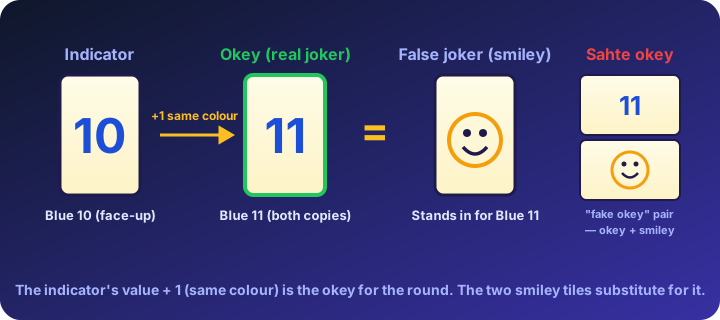
The joker is the tile of the same colour as the indicator with a number one higher — so if the indicator is Blue 10, the joker is Blue 11. Both copies of Blue 11 in the set act as the joker for this round.
Special case: if the indicator is a 13, the joker wraps to the 1 of the same colour. Indicator Red 13 → joker is Red 1.
What "joker" actually means inside a meld
When you place the joker in a run or a set, it takes the value and identity of whatever tile completes the formation. Examples:
- In a set: 8/8/joker becomes 8/8/8 — the joker is whichever colour 8 you don't have in front of you.
- In a run: Red 6 / joker / Red 8 becomes Red 6-7-8 — the joker is the missing Red 7.
- In a 4-tile set: 11/11/11/joker becomes 11/11/11/11 — joker is the fourth-colour 11.
The joker can only sit in one formation at a time. You can't use a single joker to complete two sets simultaneously.
Why the joker is worth more than its number
When the joker is, say, a Blue 11, it has 11 face-value points wherever it sits. But its real value is flexibility: it can be any tile from any meld. That flexibility translates into:
- A higher chance of opening — you essentially get to draw a tile that fits whatever you have.
- A "free" extension — you can swap the joker into another meld later if you draw the real tile it was substituting for.
- A doubled-finish opportunity — discarding the joker as your last tile doubles all scores in the round.
A rough rule: the joker is worth ~10–15 effective points beyond its face value, depending on the shape of your hand.
The two smiley tiles (false jokers)
There are two extra tiles in a 101 Okey set with smiley faces. These are the false jokers (Turkish sahte okey). They behave almost like the real joker:
- They substitute for the joker tile in any meld.
- They carry the joker's value (so each smiley is worth 11 points if the joker is Blue 11).
- They count toward the 101-point opening threshold at that value.
But they have one critical difference from the real joker: they do not count as the okey for the doubling rule. Discarding a smiley as your final tile is not a joker finish — only discarding the actual joker tile (Blue 11 in our example) doubles all scores.
The two smileys can sit in different formations within the same hand. They're identical to each other.
Sahte okey: the smiley + okey pair
You'll sometimes hear Turkish players say "sahte okey" — literally "fake okey" — to refer to a pair where one tile is the okey itself and the other is the smiley acting as the okey. This pair counts toward a 10-pair finish (it's a valid pair), and because both tiles are technically "the okey" by value, it's a moderately strong pair to be holding.
When to use the joker right away
Most rounds, you'll want to deploy the joker as soon as it completes a meld. Here's why:
- Opening matters more than holding. If the joker is the difference between opening at 95 (no good — under threshold) and opening at 110 (open and start extending), use it now.
- The longer you sit, the more chances opponents have to close. A joker held in vain for a doubled finish that never materialises is just 11 points sitting in your hand for someone else's penalty calculation.
- Joker-in-hand is visible to nobody but you. Opponents can track the real indicator, but they can't see what's on your rack. They'll often assume someone has the joker; they don't know it's you.
When to hold for a joker finish
The joker finish (çift okey / double okey) doubles all scores. That's enormous — −202 instead of −101 for the winner, +404 instead of +202 for non-openers. If you can pull it off, it's a ~3-round swing in the cumulative standings.
Hold the joker for a finish only if:
- Your other 13 tiles are already very nearly a complete hand. We're talking "I need one specific tile to finish without the joker" levels of close.
- You've already opened (otherwise discarding the joker doesn't end the round — you can't finish without having opened).
- The match is close enough that a 200-point swing meaningfully changes who wins.
If you're not within 1–2 tiles of a complete hand without using the joker, just play it. The expected value of using the joker as a flexible meld tile is much higher than the expected value of holding it for a finish that may not come.
When the joker is itself the indicator
It's not. The indicator is always one number lower than the joker, so the indicator can never be the joker. But you can have rounds where the indicator is one of the smiley tiles — see the next section.
Risk rounds: when the indicator is a smiley
When the tile flipped over at the start of the round is itself a smiley (false joker), no real okey can be derived from it. The round becomes a risk round: every score at the end is multiplied by 2 on top of any other doubling.
A pair-finish (already ×2) in a risk round (×2) is ×4 — −404 to the winner, +404 to non-openers. One round can swing the cumulative standings more than three normal rounds combined.
The strategic implication is asymmetric: in a risk round, the leading player should play defensively (because a normal-finish loss costs only −101 ÷ 2 of relative position, but a doubled penalty ruins them) and the trailing player should play aggressively for a doubled finish.
Common joker mistakes
- Slotting the joker into the first available pair. Especially with low pairs (3/3, 4/4). The joker is almost always worth more in a higher-value formation.
- Discarding the joker by accident. It happens. The indicator is sitting right there reminding you, but in a fast round people forget. Use the score tracker — at least it'll keep the cumulative damage visible.
- Holding the joker for a doubled finish on a hand that isn't close. Single biggest beginner mistake. The expected-value math doesn't work out unless you're already nearly finished.